
by András Arányi The Access Control Trie (ACT) is an essential feature designed to manage access control in Swarm’s decentralized storage infrastructure. It enables publishers to grant or revoke access to specific content at the chunk level using encrypted session keys. This guide will walk you through the key concepts…
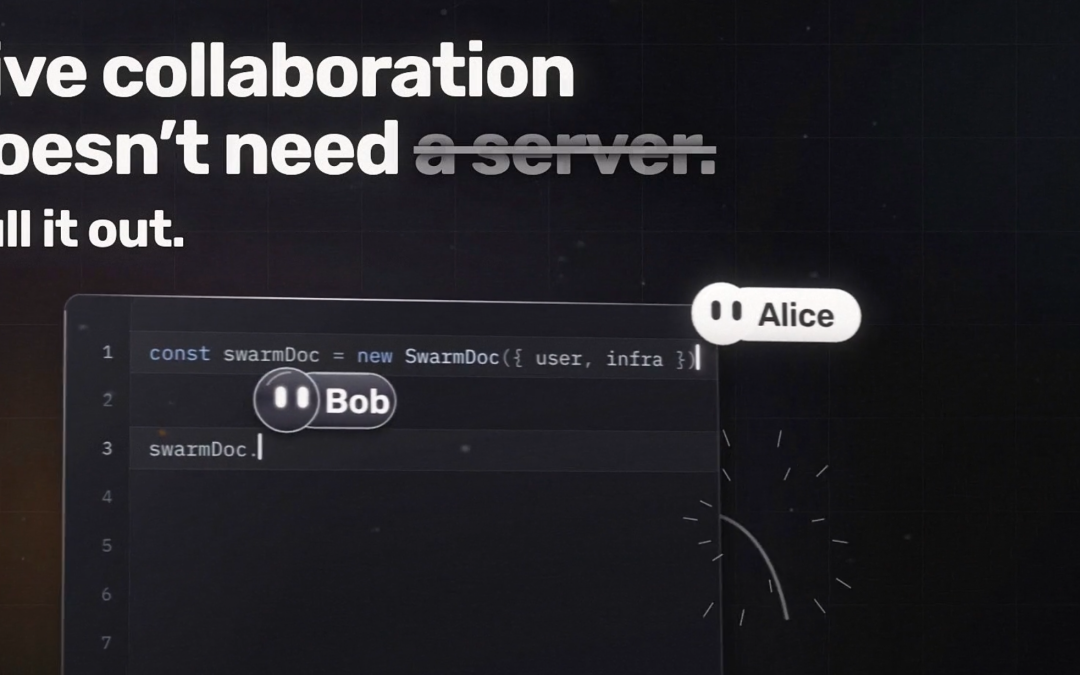
Live Coding Without a Server: Real-Time Collaborative Editing on Swarm
Our new open-source library lets people edit the same document at the same time, cursors and all, with no collaboration server in the middle. It is on npm today, and its first integration, a working proposal for Remix IDE, is open for review. Real-time collaboration has become the default way…

Live Streaming Without a Platform: Broadcasting the Ethereum Cypherpunk Congress on Swarm
Solar Punk streaming stack carries a live stage from camera to viewer with Swarm as the storage and distribution layer, and no streaming platform in the middle. Its first public run is the Ethereum Cypherpunk Congress in Mumbai on 2 November 2026, where we stream the stage as a partner…
Verifiable Words for AI Agents: Putting Sema on Swarm
When two AI agents talk to each other, how do they know they mean the same thing? Over the summer we ran a proof of concept with the team behind Sema, a protocol that gives agents a shared, verifiable vocabulary, to find out whether Swarm can serve as one of…

Unlocking the AI-Driven Health Data Economy: Your Health, Your Data, Your Equity
Discover how Health DAOs can use Swarm AI Economy solution to pool medical metrics, maximize its market value, and ensure fair, direct payouts without middle-men.

Data-enriched AI Marketplaces: From Prototype to the Future of Agentic Commerce
The future of the internet belongs to autonomous agents – but how will these agents securely discover, trade, and pay for data without relying on centralized, monopolistic platforms? Agent markets require autonomy, but autonomy only works when buyer agents can inspect provenance, persistence, review history, and payment records before making…

Swarm Mobile: Web3 Power in Your Pocket
Discover Swarm Mobile, the new app bringing Web3 decentralized storage to Android. Learn how to run a Swarm Bee node and secure your digital sovereignty.

The Swarm File Manager: Bridging the Gap Between Web2 Comfort and Web3 Power
In our previous update, we introduced the concept of the Swarm File Manager: a radical layer of abstraction designed to make the unstoppable Swarm network as easy to use as a standard USB drive. Today, we are thrilled to announce that the vision is now a reality. The release of…
The Evolution of Streaming on Swarm: Introducing MSRS
Earlier this year, we took a significant step forward in decentralized multimedia with the release of our open-source multimedia libraries and the launch of the Multimedia Streaming Social Demo (MSSD). The MSSD was a proof of concept that demonstrated the power of live streaming on Swarm, showcasing a future free…

The Swarm File Manager: Bringing Cloud Storage Usability to Decentralized Storage
Swarm is the resilient, censorship-resistant, decentralized storage and communication layer of Web3. Its core strength lies in its layered design: the interwoven systems of Postage Stamps, Feeds, Chunking, and Incentives that ensure data persistence and integrity without reliance on any central server. However, complexity is the enemy of adoption. To…

From Universal Adapters to Decentralized Minds: The MCP Revolution
We should strive for a future where AI evolves not as a monolithic power in the hands of a few, but as a vibrant, decentralized ecosystem nurtured by many. We argued that this future is not only possible, but is actively being built on Swarm. That vision is no longer…
No Results Found
The page you requested could not be found. Try refining your search, or use the navigation above to locate the post.

Introducing the Access Control Trie (ACT) in Swarm
by András Arányi The Access Control Trie (ACT) is an essential feature designed to manage access control in Swarm’s decentralized storage infrastructure. It enables publishers to grant or revoke access to specific content at the chunk level using encrypted session keys. This guide will walk you through the key concepts…
Live Coding Without a Server: Real-Time Collaborative Editing on Swarm
Our new open-source library lets people edit the same document at the same time, cursors and all, with no collaboration server in the middle. It is on npm today, and its first integration, a working proposal for Remix IDE, is open for review. Real-time collaboration has become the default way…
Live Streaming Without a Platform: Broadcasting the Ethereum Cypherpunk Congress on Swarm
Solar Punk streaming stack carries a live stage from camera to viewer with Swarm as the storage and distribution layer, and no streaming platform in the middle. Its first public run is the Ethereum Cypherpunk Congress in Mumbai on 2 November 2026, where we stream the stage as a partner…

Verifiable Words for AI Agents: Putting Sema on Swarm
When two AI agents talk to each other, how do they know they mean the same thing? Over the summer we ran a proof of concept with the team behind Sema, a protocol that gives agents a shared, verifiable vocabulary, to find out whether Swarm can serve as one of…

Unlocking the AI-Driven Health Data Economy: Your Health, Your Data, Your Equity
Discover how Health DAOs can use Swarm AI Economy solution to pool medical metrics, maximize its market value, and ensure fair, direct payouts without middle-men.

Data-enriched AI Marketplaces: From Prototype to the Future of Agentic Commerce
The future of the internet belongs to autonomous agents – but how will these agents securely discover, trade, and pay for data without relying on centralized, monopolistic platforms? Agent markets require autonomy, but autonomy only works when buyer agents can inspect provenance, persistence, review history, and payment records before making…
Swarm Mobile: Web3 Power in Your Pocket
Discover Swarm Mobile, the new app bringing Web3 decentralized storage to Android. Learn how to run a Swarm Bee node and secure your digital sovereignty.
The Swarm File Manager: Bridging the Gap Between Web2 Comfort and Web3 Power
In our previous update, we introduced the concept of the Swarm File Manager: a radical layer of abstraction designed to make the unstoppable Swarm network as easy to use as a standard USB drive. Today, we are thrilled to announce that the vision is now a reality. The release of…
The Evolution of Streaming on Swarm: Introducing MSRS
Earlier this year, we took a significant step forward in decentralized multimedia with the release of our open-source multimedia libraries and the launch of the Multimedia Streaming Social Demo (MSSD). The MSSD was a proof of concept that demonstrated the power of live streaming on Swarm, showcasing a future free…
The Swarm File Manager: Bringing Cloud Storage Usability to Decentralized Storage
Swarm is the resilient, censorship-resistant, decentralized storage and communication layer of Web3. Its core strength lies in its layered design: the interwoven systems of Postage Stamps, Feeds, Chunking, and Incentives that ensure data persistence and integrity without reliance on any central server. However, complexity is the enemy of adoption. To…
From Universal Adapters to Decentralized Minds: The MCP Revolution
We should strive for a future where AI evolves not as a monolithic power in the hands of a few, but as a vibrant, decentralized ecosystem nurtured by many. We argued that this future is not only possible, but is actively being built on Swarm. That vision is no longer…
Tags